
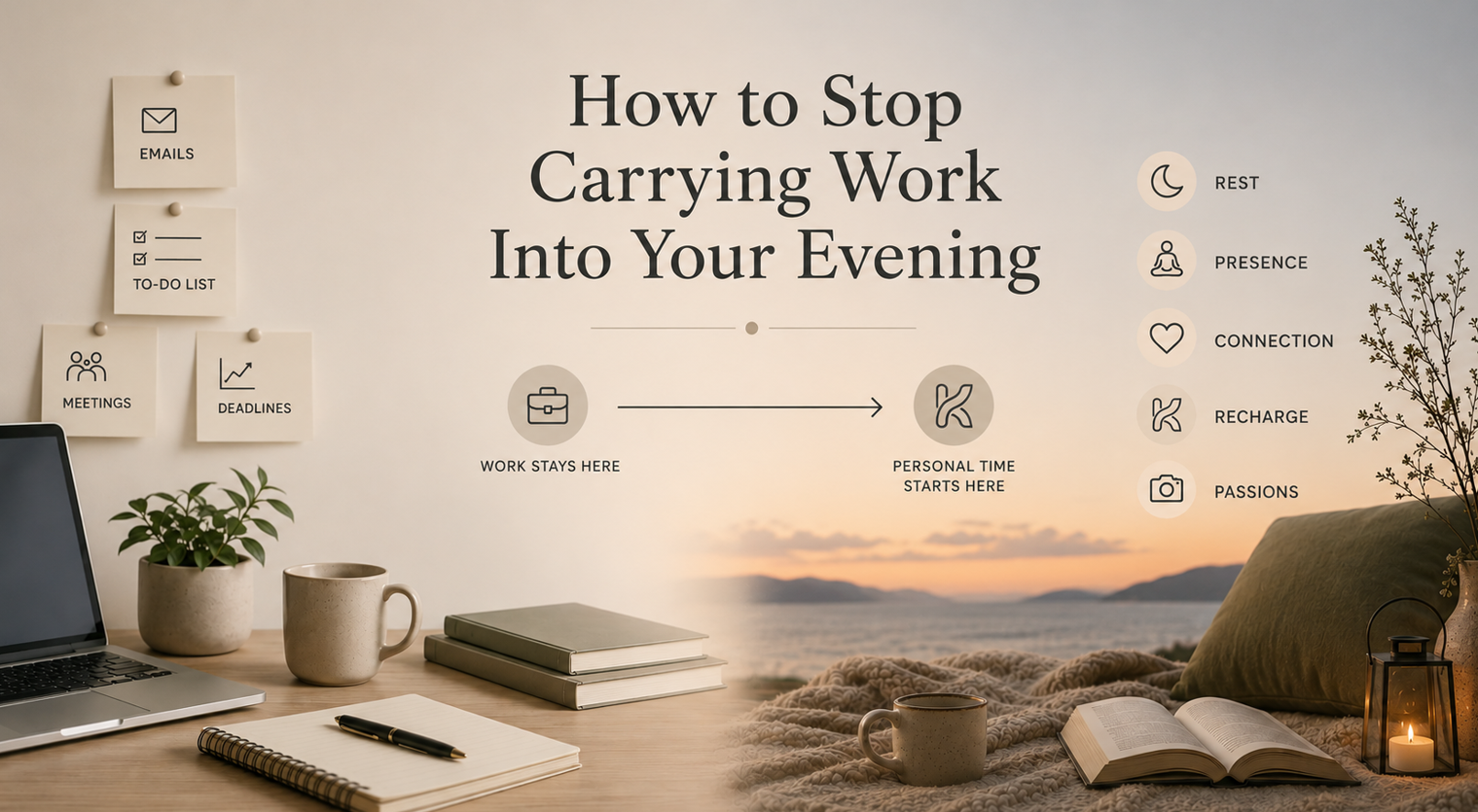
Why is it that despite closing your laptop, making dinner, sitting down, you’re still at work? You think about that email you forgot to send, about a meeting you need to have tomorrow, and about something that is not quite resolved. All these thoughts follow you into the evening, and before you know it the hours you had set aside for rest are spent mentally rehearsing the next day instead.
The reason is very much biological and understanding that changes everything.
Why the brain finds it so hard to stop
The prefrontal cortex does not have an off switch. When work has occupied it all day, it keeps processing even after you have physically stopped. The working memory is still very much occupied by unfinished tasks. Researchers call this the Zeigarnik effect: the brain treats incomplete things as open loops and returns to them repeatedly, looking for resolution. Research by Sonnentag and Fritz (2007) found that genuinely switching off from work during the evening is one of the strongest predictors of next day energy and focus. People who properly detach in the evening consistently show better mood, sharper thinking and lower fatigue the following day.
The difficulty lies in that detachment does not happen on its own, it needs a little help.
Three things that work
- Build a closing ritual
It is crucial to give your brain a clear signal that the day is done. This can be as simple as writing down your three priorities for tomorrow, closing your tabs and tidying your desk. Something small and consistent is effective in telling your nervous system that “this part of the day is finished”. Without that signal, the brain keeps the loops open.
- Take a short walk
Ten minutes of movement after work does something that willpower cannot. Movement interrupts the mental pattern of the day, lowers cortisol and gives the brain’s restorative Default Mode Network a chance to activate. It does not have to be intense exercise or long walk; you just need to move.
- Be intentional about the first hour
The transition from work to evening sets the tone for everything that follows. Even if you are working from home, checking emails, scrolling, or watching something loud and fast tends to keep the brain in a reactive state. Something quieter such as a conversation, cooking, reading, and time outside, gives the nervous system room to settle before the evening disappears.
On the guilt that keeps us connected
A lot of people carry work into their evenings not because they cannot stop, but because they feel they should not. Staying mentally connected to work has come to feel like a sign of dedication. The research tells a very different story.
Recovery is not time away from performance, it is what makes sustained performance possible. Therefore, protecting your evening is not about switching off, it is about showing up properly the next day.
At KALO SPACE, we write about the science and practice of working sustainably, with clarity, intention, and without burning out. Explore more at kalospace.com.